
The Indonesia Stock Exchange (IDX) has faced its most severe stretch of selling in decades. Its main benchmark, the Jakarta Composite Index (IHSG), fell sharply in January 2026 and again on October 16, 2026, when the exchange halted trading twice in a single morning. Both episodes were triggered by decisions or proposals from index provider MSCI concerning how Indonesian stocks are classified. The crashes also exposed deeper worries about ownership transparency, fiscal policy, and central bank independence. This guide explains what happened on the Indonesia Stock Exchange, why it happened, how trading halts work, and what the episode means for the rest of Asia.
The January 2026 crash
The first major sell-off began on Wednesday, January 28, 2026. The IHSG opened down 6.66% at 8,382.48 after MSCI announced it would temporarily freeze the rebalancing of Indonesian equities within its global indexes. Funds and ETFs that track MSCI benchmarks are large buyers of Indonesia’s biggest companies, so the freeze removed a steady source of demand.
On the following day, the index fell roughly 8% to 10% at its worst, according to AFP and The Jakarta Post, the sharpest decline since the 1998 Asian financial crisis. Trading was halted when losses crossed the threshold. Reporting estimated that about US$80 billion in market value was wiped out. On January 30, the exchange’s chief executive resigned, a move that many observers linked to the crisis.
Regulators responded by announcing that the minimum free-float requirement would rise from 7.5% to 15%, with companies that could not comply placed under special supervision. Authorities also committed to meeting MSCI’s transparency requests before May 2026.
The Spring rebound and relapse
After the reform announcements on April 2, 2026, the market recovered about 8% over the following weeks. The recovery was fragile. On April 24, the IHSG fell 3.06% to 7,152.85 as renewed MSCI concerns and a weaker rupiah hit investor sentiment.
Through the early summer, the index continued to trade in a volatile, downward range. It fell 1.62% to 6,002 during a June 24 morning session, when the rupiah approached 18,000 per dollar. MSCI kept Indonesia in its emerging-market classification at that review, which was a relief, but its scrutiny of ownership transparency and possible coordinated trading continued. The IHSG closed at 6,236 on July 31.
The October 2026 sell-off on the Indonesia Stock Exchange
The second and sharper crash came in mid-October.
- October 15: The IHSG closed at 5,863.78, down 1.33%. That evening, MSCI announced a proposal to reclassify Indonesia’s market from an emerging market to a standalone market. Some reports also referenced a possible frontier-market designation. The final decision on reclassification is expected no later than the end of June 2027.
- October 16, morning: The IDX opened sharply lower. At 8:58 a.m., Jakarta time, the exchange triggered a 30-minute trading halt after the IHSG fell more than 8%, opening at 5,393.92, down 8.01%. Trading resumed at 9:28 a.m. with no change to the regular schedule.
- October 16, first session close: The index fell further after the reopening. It closed the first session down 10.76% at about 5,233, within a range of 5,193 to 5,404. Trading volume reached 37.9 billion shares, worth Rp17.32 trillion. Some 809 stocks fell, only 15 rose, and 139 were unchanged. Every sector finished in the red. Materials fell 12.96%, energy fell 12.21%, and infrastructure fell 12.13%. Later in the morning, the index hovered near 5,254, still down more than 10%.
Senior officials visited the exchange building that afternoon, including the deputy speaker of the national parliament and the head of Danantara, the state investment agency. Their visit drew attention because it signaled that the government viewed the sell-off as a national market concern.
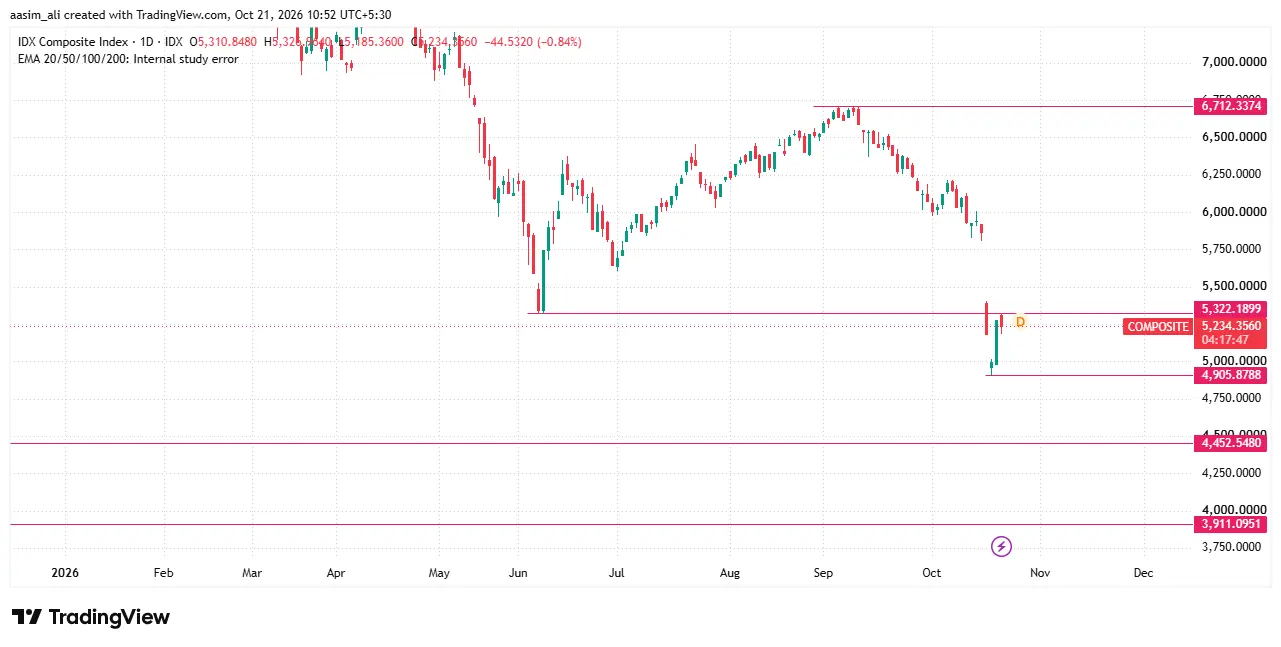
IDX is in trouble: Will buyers bounce back or will sellers hold their grip?
The IDX composite index (IDX) price has witnessed the biggest sell-off in the past three decades. It has been falling since the beginning of 2026. IDX price has dropped by roughly 40% since 2026 and has touched 5,000 points after 2021. IDX price experienced a retracement of 26% from June to August but sellers bounced back and continued the bearish trend.
On October 16, 2026, the IDX price witnessed a gap down of 8%, which created panic in the Indonesian stock market. Most of the Indonesian stocks kept falling on Friday and bears were in full control. IDX dropped by 3.87% after the opening.
On Monday (19th Oct), IDX continued its bearish trend and witnessed a gapdown of 4.2%. However, buyers bounced back and held the price above the 4,900 level. Since then, the price has recovered around 7.52% in 2 days, which shows that buyers have bounced back.
If the price manages to defend the psychological level of 5,000 points, buyers might be confident. If things go in favor, any bullish move can trigger a buying momentum. If investors show interest, IDX can recover previous losses and can extend to the September high.
Conversely, if the IDX price slips below the 4,900 point, then sellers could dominate further. If sellers continue their domination, the price can drop to the next support level of 4,450 points. Once buyers fail to defend this level, it may melt to the 3,911 level.
Why did the Indonesia Stock Exchange Crash?
The MSCI free-float issue
Free float is the portion of a company’s shares that is actually available for public trading, excluding stakes held by controlling shareholders, governments, and strategic investors. Index providers use free float to determine how much of a stock global funds should hold. If Indonesian companies’ free float is overstated, global funds may end up owning more of a stock than the market can supply, which distorts prices and can create artificial demand.
MSCI has said it is concerned about low transparency in ownership, which makes it difficult to determine true public float. Investors have also raised questions about coordinated trading behavior. The reclassification proposal of October 2026 signaled that these concerns could reduce Indonesia’s standing among emerging markets.
Fiscal policy and government intervention
Foreign investors have grown more cautious about Indonesia’s widening fiscal deficit and the government’s larger role in financial markets under President Prabowo Subianto. The sudden dismissal of Finance Minister Sri Mulyani Indrawati in 2025 also shook confidence in fiscal management. Overseas investors sold 13.96 trillion rupiah, about US$834 million, of Indonesian shares in 2025, the worst year for outflows since 2020.
Central bank independence
In January 2026, the government appointed a nephew of the president, Thomas Djiwandono, to the central bank’s board. Many investors interpreted the move as a challenge to the central bank’s independence, which weakened confidence in monetary policy and the rupiah.
Currency pressure
The rupiah reached a record low of 16,985 per dollar in late January and was near 18,000 by late June. Foreign investors who sell Indonesian shares usually convert the proceeds to dollars, so a falling rupiah can intensify selling in the stock market. Bank Indonesia has also been reported to expect continued capital outflows.
The Impact on the Rest of Asia
The Indonesia Stock Exchange crash has been largely country-specific, but it carries implications for the region.
On the first day of the January sell-off, the reaction in neighboring markets was mixed. Japan’s Nikkei fell about 0.55%, while Hong Kong’s Hang Seng rose about 1.13%. This suggests that investors treated Indonesia’s problems as local rather than a sign of a regional downturn. I could not confirm regional index moves for October 16 from the reporting I reviewed, so the regional picture for that day remains incomplete.
The more significant channels are indirect:
- Passive fund flows: Index-tracking funds across Asia and worldwide follow MSCI decisions. Changes to Indonesia’s classification can affect flows into other emerging markets, especially if investors reassess their broader exposure to Southeast Asia.
- Currency and capital pressure: When a large regional market faces outflows, investors often re-evaluate peers, demanding higher risk premiums and pulling capital from exposures seen as similar. This can pressure other Southeast Asian currencies and stock markets.
- Transparency standards: Other markets with similar concerns about ownership disclosure may face closer index scrutiny. Regional regulators are watching how Indonesia responds.
- Investor risk appetite: Risk-off episodes often lead investors to shift toward the US dollar and other perceived safe assets, which can weigh on emerging-market equities as a group.
What should investors watch?
For anyone following the Indonesia Stock Exchange, these signals matter most:
- The MSCI reclassification process and its final decision expected by June 2027.
- Free-float implementation, including whether companies meet the 15% requirement.
- Ownership disclosure and KSEI reporting, which MSCI and investors use to assess transparency.
- Foreign net flows, reported regularly by the exchange and regulators.
- Rupiah stability and any intervention by Bank Indonesia.
- Central bank governance, including board appointments and policy signals.
- Regional contagion, particularly moves in other Southeast Asian indexes and currencies.
Conditions can change quickly, and this article is informational rather than investment advice. Investors considering exposure to Indonesian equities should weigh their own risk tolerance and consult a qualified financial advisor.
What is the Indonesia Stock Exchange?
The Indonesia Stock Exchange, known as Bursa Efek Indonesia or IDX, is the national exchange where Indonesian shares, bonds, and other securities are traded. Its main index is the Jakarta Composite Index (IHSG).
Why did the Indonesia Stock Exchange crash in 2026?
The crashes were triggered by MSCI’s decisions and proposals on Indonesian stock classification, which raised concerns about free float and ownership transparency. Fiscal policy worries, central bank independence concerns, and a weaker rupiah added to the selling.
What happened on October 16, 2026?
The IHSG opened down 8.01%, triggering a 30-minute trading halt. After trading resumed, the index closed the first session down 10.76% at about 5,233. Every sector fell.
What is a trading halt on the IDX?
A trading halt pauses trading for 30 minutes when the IHSG falls more than 8% in a day. A second 30-minute halt applies above 15%, and a suspension applies above 20%.
What is MSCI’s proposal for Indonesia?
MSCI proposed reclassifying Indonesia’s market from an emerging market to a standalone market, with reports also mentioning frontier status. The final decision is expected no later than the end of June 2027.
What is free float and why does it matter?
Free float is the share of a company’s stock that is available for public trading. Index providers use it to set weights, and overstated free float can distort prices and index flows.
How much value was lost in the January 2026 crash?
Reporting estimated that about US$80 billion in market value was wiped out during the two-day sell-off in late January.
Did the crash affect other Asian markets?
Early reactions in other markets were mixed. The main effects have come through index-tracking fund flows, currency pressure, and investor reassessment of emerging Asia.
Is the Indonesia Stock Exchange still falling?
Prices move daily, and the most recent reporting I reviewed covers October 16, 2026. Check the exchange’s official data for the latest levels.
Is it a good time to invest in the Indonesia Stock Exchange?
This article does not provide investment advice. Investors should consider the risks of reclassification, currency movements, and policy uncertainty and consult a qualified financial advisor.