

We all know how Cryptocurrency has been the talk of the town in the last few years. Its rise is something truly commendable. What makes it more interesting at today’s date is the competition that is currently going on between all the countries to grab the number one spot in the Global Crypto Adoption Index.
Let’s take a deep dive into the intricacies of Crypto Adoption and how all the countries are performing there.
Understanding Global Crypto Adoption Index With SunCrypto.
Before diving deep into all the further details, let’s take some time to understand what this Index is about.
This can be described as a comprehensive tool to understand to what extent the leading countries are involved in using crypto assets. To make it more easily understandable, we can consider this a report card that evaluates each country’s progress in becoming familiar with crypto assets.
The working of this index is influenced by various factors but the major ones are discussed here:
- Number of Users: Obviously, the higher a country’s number of crypto users, the higher it is listed in the index. This also signifies how well the country’s common public is embracing crypto assets, thus proving it to be a major deciding factor.
- Volume of Transactions: The number of crypto transactions carried out daily, also serves as a deciding factor in this context. You see, it might not always be necessary that the higher the number of users, the higher the listing, sometimes, daily users might not find it important to make a transaction in a long time. Thus, the volume of transactions is also crucial.
- Growth of Crypto-Related Businesses: How popular are the crypto-related businesses running in the country? Are they successful? How much do the common people trust these companies? All this plays a major role.
Apart from these factors, experts also use key indicators like retail activity, institutional participation, etc.
Now that we have gone through the above-influencing factors, it becomes clear to us what the basic goal of the index is – to evaluate how much is Crypto integrated into the day-to-day life of the people of the particular country. A country listed higher in the index will have large business acceptance as well as a major chunk of the population using crypto in their day-to-day lives.
How Crypto Adoption Index Works?
At this point, it becomes fairly evident that this index doesn’t only deal with a country’s dominance over crypto assets but also something deeper and more insightful. To understand this even better, we need to know that this index focuses on three different core areas – Transaction Volume, Peer-to-peer (P2P) trading, and weighted analysis.
Firstly, an increase in transaction volume may correlate to increased usage, adoption, and trading on the network. It might be a sign of emerging interest, a new utility for the currency, or even speculative fever. Lower on-chain transaction volumes might be an indication of the reduction in network development, protocols stagnating, and possibly losing market share to competing entities.
Next, experts take the help of Peer-to-peer (P2P) trading. They are trading platforms, facilitating peer-to-peer transactions over the internet without third parties like brokerages or banks. To buy or sell given cryptocurrencies at market prices, market traders can offer listings, which counterparties can then reach out to so that a trade can take place. You see, this becomes crucial in areas where there is limited access to traditional financial services, thus making this a must for users to trade crypto directly in such areas.
The final piece of this puzzle comes in the form of a weighted analysis, which considers everything, such as the population and the economic situation in one country compared to another, to make fair comparisons. A particularly important component of this is the adjustment factor for purchasing power parity, which counters differences in cost-of-living levels between countries.
Thus we can conclude that working on these 3 particular core areas, the Adoption Index is successful in putting forward a clearer view of how crypto is impacting individuals in a particular country rather than just depicting an outer picture.
Current Global Trends For Crypto Adoption.
When we come to think about how crypto is adopted across the world, a very interesting picture comes to the limelight, as we see the gap created between developing and developed countries regarding crypto adoption.
Of course, the early adopters are the United States, Japan, and South Korea, but many of the significant increases in crypto usage are occurring in emerging markets.
Take Argentina and Brazil, for instance. Those countries have experienced increases in crypto adoption, primarily because of economic instability and higher inflation rates.
Africa is the third continent that reveals very high rates of crypto adoption, with countries like Nigeria and Kenya leading the pack. Of all Nigerian citizens, nearly 45% have interacted with cryptocurrency in one way or another, because the majority of Nigerians remain unbanked.
This shift does not seem to have changed much, as Southeast Asia remains the majority of countries with the highest adoption rates, primarily Vietnam and the Philippines. Blockchain-based gaming as well as play-to-earn models, where users earn crypto by playing online games, captured the attention of young populations who are seeking new income opportunities in a region with relatively lower wages.
Now, if we take into account the global crypto adoption report by Chainalysis, it has taken a major jump between 4th Quarter’2023 to 1st Quarter’2024, making India top the list, as compared to 2021. Refer to the report below:
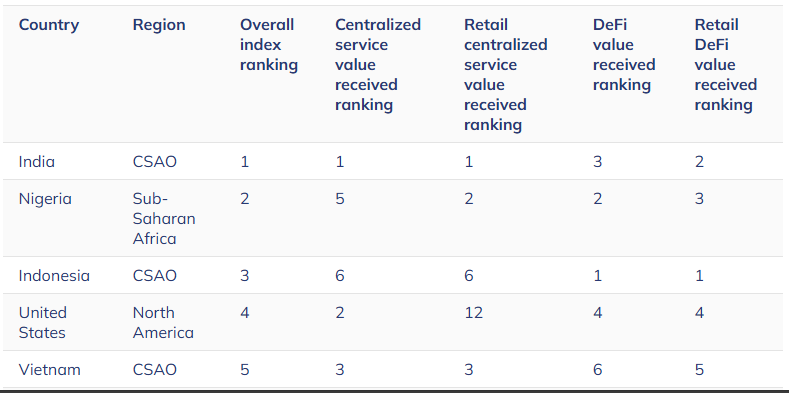
As we can see from this report, usage jumped dramatically in places like Nigeria, India, and Vietnam, as crypto provided a lifestyle for users who sought to evade the variously weakened national currencies- whether by way of inflation or just simple economic instability.
What is the Current Status of Crypto Adoption in India?
The fate of Cryptocurrency has been through a huge roller coaster ride in India. Earlier, the use of crypto was banned in India, but in March 2020, India’s supreme court overturned a digital currency trading ban imposed by the RBI.
Now this means that Cryptocurrencies are not illegal in India, therefore, people are free to purchase, hold, or trade cryptocurrencies. Still, the Indian government and regulatory authorities had been cautioning about the risks involved with cryptocurrencies and were attempting to create some form of regulatory framework. Following is the timeline of regulatory developments that happened during this period:
- Supreme Court Order, (2020): The Supreme Court of India cancelled the Reserve Bank of India’s (RBI) directive to ban transactions in cryptocurrencies. Initially, RBI had placed a ban that restricted access of banks and financial institutions to the services related to cryptocurrencies. With this matter, the Supreme Court’s decision also became a landmark for the Indian crypto industry.
- Taxation: According to ET, The budget for the year 2022 brought a tax of 30% on income obtained through crypto-transactions, at the same time charging 1% TDS on such transactions as well. As of now, analysts consider it one step forward towards acceptance and regulation despite the currencies not being assigned the status of legal tender.
- Regulatory Proposals on Crypto Currencies: The Indian government has decided to introduce cryptocurrencies with some unique legislation framework for them. It has been rumoured about a bill that seeks to regulate digital currencies. It may suggest the creation of an official RBI-issued digital currency and regulation or prohibition of some private cryptocurrencies. However, until the last update, no such law existed.
- RBI’s Opinion: The Reserve Bank of India has thus far maintained a conservative opinion over cryptocurrencies. They have voiced their concerns over the risks to financial stability, investor protection, and the potential misuse of this form of currency for illegal purposes. RBI is also working on an official digital currency called the Central Bank Digital Currency-CBDC.
What are the Factors Influencing Crypto Adoption in India?
As we understand the details of Crypto Adoption, we see that there are a vast number of factors that influence this. Let’s understand some of them:
- Economic Instability: For countries where there is ongoing economic instability, there are chances where people find it easier to switch to crypto for safer transactions and better stability.
- Lack of Traditional Banking: That’s another crucial factor and it mainly takes place in many developing countries where major sectors are unbanked. Limiting their access makes them automatically shift to Crypto transactions.
- Government Regulations: Countries with flexible government regulations regarding crypto transactions makes them experience higher adoption rates
What are the Benefits of Crypto Adoption in India?
Crypto Adoption comes with a wide range of benefits, these mainly include:
- Financial Inclusion: Through the use of crypto, people can easily save and invest money without the need for a bank account, thus removing the need for fees in cross-border payments.
- Democratization of Finance: This also enables users to perform transactions on their own without relying on any government authority.
- Economic Stability: For countries facing currency volatility, crypto helps by storing value, thus offering citizens an alternative to their falling currency value.
Conclusion
The future of crypto assets in the world looks bright to be honest, as even more players increasingly enter the crypto space with greater ease; this is expected to increase activity in high-income countries. It is more than enough that the introduction of products such as Bitcoin ETFs has already demonstrated the strength of institutional interest to push the adoption of such products.
In the coming years, more traditional financial institutions such as banks and hedge funds may begin offering more crypto-related services, and the index of crypto adoption in wealthier regions may rise.
It can be safely said that by competing for a higher place in the Global Crypto Adoption Index, countries are not only becoming efficient but also carving a better future for themselves in the digital market.
To learn more about Global Crypto Adoption, go check out SunCrypto Academy.
Disclaimer: Crypto products and NFTs are unregulated and can be highly risky. There may be no regulatory recourse for any loss from such transactions. All content provided is for informational purposes only, and shall not be relied upon as financial/investment advice. Opinions shared, if any, are only shared for information and education purposes. Although the best efforts have been made to ensure all information is accurate and up to date, occasionally unintended errors or misprints may occur. We recommend you do your research or consult an expert before making any investment decision. You may write to us at help@suncrypto.in.