
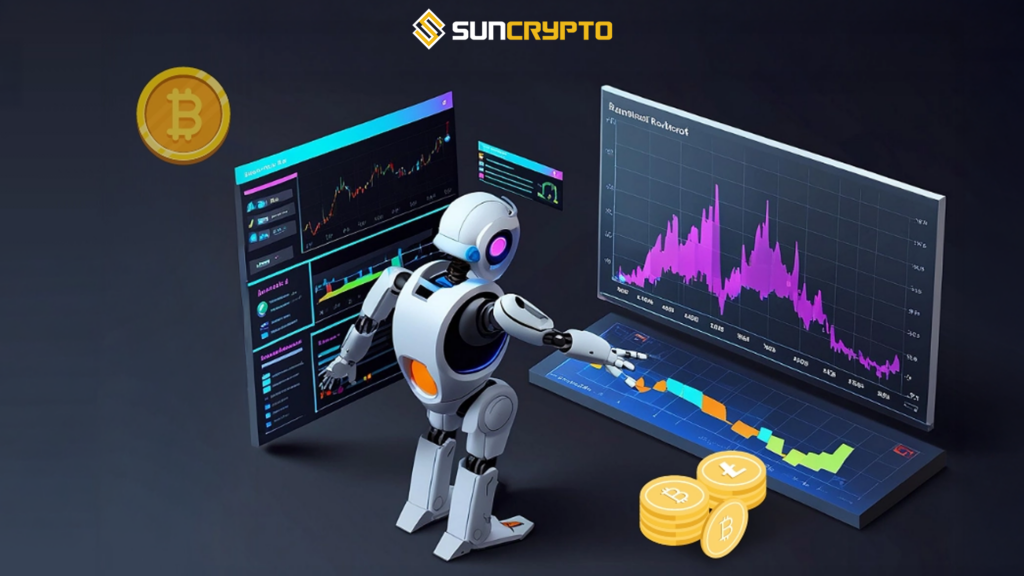
Connecting AI agents to crypto exchanges involves integrating autonomous, self-learning software programs with exchange infrastructure to automate trading, analyze market data, and manage portfolios in real-time. These agents, which often use machine learning and natural language processing (NLP), can operate 24/7, executing trades faster than humanly possible and adapting to market volatility.
Key Aspects of Connecting AI Agents to Exchanges:
- API Integration: Agents connect to exchanges (like Binance, Coinbase, Kraken, or DEXs) using REST or WebSocket APIs to fetch live market data and execute orders.
- Secure Authentication: To avoid risks, it is highly recommended to use sub-accounts with limited permissions and IP whitelisting when connecting API keys to AI agents.
- Types of Agents:
- Trading Agents: Execute automated trades based on AI-driven strategies.
- Portfolio Management Agents: Rebalance assets in real-time to optimize returns.
- Security/Fraud Detection Agents: Monitor for suspicious activity and unusual transactions.
- Tools for Integration: Platforms like n8n can be used to build workflows that connect AI agents (using LLMs like OpenAI’s GPT) to exchanges.
- Advantages:
- 24/7 Operation: Continuous market monitoring and trading.
- Speed and Efficiency: Instant execution of trades and analysis of large datasets.
- Emotional Detachment: Decisions are based on data, not fear or greed.
- Personalization: Tailored investment strategies.
- Risks and Challenges:
- Security Risks: Potential for unauthorized access or theft of funds if not properly secured.
- Market Volatility: AI may not always predict sudden market shifts accurately.
- Technical Failures: Dependence on API stability and data quality.
Steps to Connect an AI Agent:
- Define Strategy: Determine the goals (e.g., arbitrage, trend following).
- Select Tools: Choose AI agent frameworks and platforms.
- API Keys: Generate secure, restricted API keys from the exchange.
- Integration: Connect the agent to the API.
- Testing: Test in a simulated (testnet) environment.
- Deployment: Launch on the mainnet, with continuous monitoring.
Popular platforms for building these agents include Fetch.ai, SingularityNET, and various open-source libraries that enable autonomous actions.
How Crypto Trading AI Agents Work?
Here is the step-by-step process to understand how AI agents in crypto trading work:
Step 1: Collecting Data: The agent collects data from multiple sources, including social media platforms, exchanges, blockchains, and news.
Step 2: Analyzing Market: Smart agents then utilize ML models to analyze the market to find out patterns and forecast price trends.
Step 3: Formulate Trading Strategies: This involves considering market insights to build and test trading strategies.
Step 4: Executing Trades: AI agents can independently execute trades and rebalance assets. They do the same in this step.
Step 5: Monitoring Performance: Agents can track results or the performance of crypto in real-time. They make the required adjustments.
Step 6: Learning and Evolving: Smart trading bots improve their accuracy and performance by looking into the received feedback on past trades and evolving market data.
Steps to Build AI Agents for Crypto Trading
Building a crypto trading AI agent needs expertise in artificial intelligence, machine learning, blockchain, and other emerging technologies. Then you need to follow this practical roadmap to building an AI agent in crypto trading:
Step 1: Define the Trading Strategy and AI Agent Needs
The first step is to define the goal you want to achieve by building an AI crypto trading agent. Whether it is about executing trades, detecting fraud, or identifying price gaps across exchanges, mention it clearly and prepare the right trading strategy that will bring life to this vision.
Step 2: Collect and Preprocess Data
Mention the sources of the trading data that the intelligent agent will consider while performing its functions. Make sure the sources are reliable and data, such as price history, transaction volumes, or market sentiments, are relevant. Clean and process the data, if necessary.
Step 3: Design AI Agent Architecture
Now, decide which type of AI agent would suit your requirements. You can choose between reactive, predictive, or hybrid agent models after considering their specific functionality. Make sure you pick the one with modular decision layers.
Step 4: Integrate with Exchanges and Smart Contracts
The next step to build an AI crypto trading agent is to leverage REST or WebSocket APIs to connect with crypto trading platforms and exchanges. Make sure you choose the right API and architecture for the agent creation and integration.
Step 5: Implement Learning Mechanisms
Clearly implement top-notch learning mechanisms, such as reinforcement learning or supervised learning. This will enable the agent to make adaptive decisions. Apart from this, connect agents to crypto exchanges, DeFi protocols, or wallets for automated execution.
Step 6: Set Risk Mechanisms and Compliance Rules
The next step is to thoroughly define stop-loss, portfolio limits, and KYC/AML monitoring logic. This will ensure that the trades that are being executed comply with regulatory requirements and compliance.
Step 7: Test
Test the agent in simulated environments and make changes, if required. Test its functionality, performance, and other critical performance indicators. Refine the agent or retrain it in case there is an error in the output.
Step 8: Deploy and Monitor
Launch the AI crypto trading agent and continuously monitor its performance. Also, review user feedback and implement changes from time to time to ensure it doesn’t impact user experience.
Indian Exchanges introduced AI Agents on their platform:
In 2026, the leading Indian crypto exchanges have integrated sophisticated AI capabilities to enhance the trading experience:
- Mudrex has revolutionized user interaction by launching Mudrex AI, an embedded intelligence layer that provides contextual portfolio analysis, alongside the Mudrex MCP Server, which allows traders to link external AI agents like Claude to execute trades using natural language.
- ZebPay has transformed its platform into a proactive financial companion by introducing AI Insights for predictive market forecasting and AI-Integrated Smart Wallets that utilize behavioral biometrics and real-time transaction monitoring to detect fraud and suspicious activity.
- CoinDCX focuses on professional-grade automation by offering an advanced API Trading Stack that enables developers to deploy autonomous agents, while also using machine learning to optimize its “Earn” features and provide real-time trade signals based on complex market data.
- CoinSwitch has prioritized investor safety by deploying AI Risk Intelligence tools that scan the blockchain to flag “Honeypot” scams and liquidity risks, while also serving as a discovery hub for emerging Web3 AI agent tokens on high-speed networks like Solana.
Disclaimer: Crypto products & NFTs are unregulated and can be highly risky. There may be no regulatory recourse for any loss from such transactions.