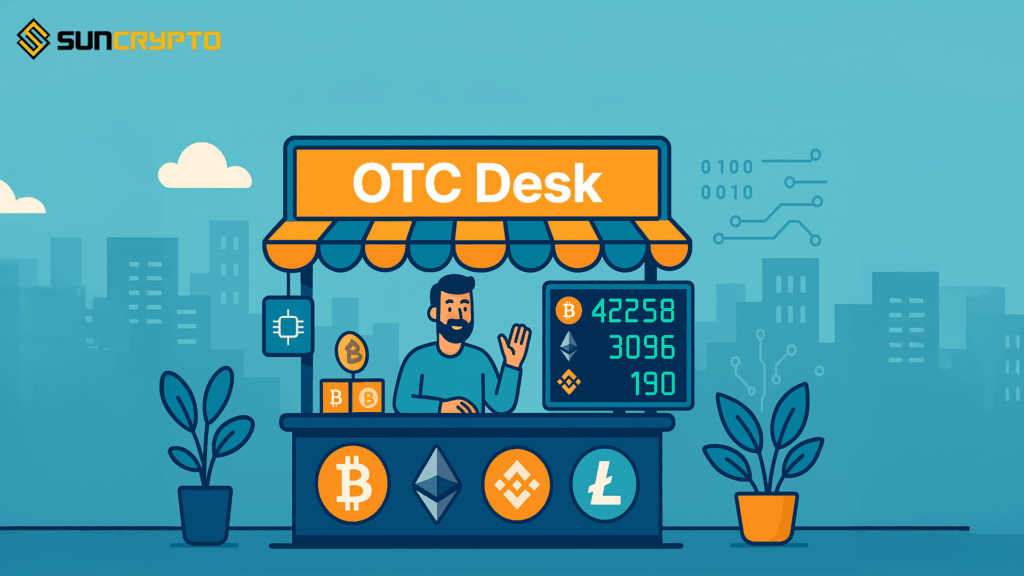
The Over-the-Counter (OTC) market is a decentralized trading network that operates outside the traditional, public order books of centralized exchanges. It is where transactions are conducted directly between two parties, often facilitated by a specialized trading firm known as an OTC desk trade.
For high-net-worth individuals (HNIs), institutional investors, and corporations in the cryptocurrency space, the OTC market—including the SunCrypto OTC Desk—is an essential service for executing large-volume trades with minimal market impact.
OTC Definition and Purpose
An Over-the-Counter (OTC) market is a decentralized system where securities, commodities, derivatives, and, critically, cryptocurrencies are traded directly between two counterparties, typically using broker-dealers as intermediaries. The term “over-the-counter” originates from the old practice of trading literally over the counter of a bank or brokerage office.
In the context of cryptocurrency, the primary function of an OTC desk trade is to execute large block trades—often exceeding ₹10 Lakhs—without utilizing the exchange’s public order book.
Types of OTC Markets
While the overall concept is the same (decentralized trading), OTC markets are categorized based on the underlying asset and the nature of the transaction:
1. Crypto OTC Desks (e.g., SunCrypto OTC Desk)
- Focus: Large-volume transactions in cryptocurrencies (BTC, ETH, stablecoins, etc.) and fiat currencies (INR, USD).
- Mechanism: SunCrypto’s OTC desk is a premium service that matches a buyer with a seller, or acts as the counterparty itself, to settle the trade quickly and discreetly off-exchange.
- Goal: Ensure a single, locked-in price for the entire large order, protecting the client from slippage and market volatility.
2. Traditional Securities OTC Markets
- Bonds and Debt: The vast majority of the global bond market (corporate, municipal, and government bonds) is traded OTC due to the customized nature and large size of the transactions.
- Derivatives: Customized contracts like forward contracts, swaps, and non-standard options are primarily traded OTC because they are not standardized enough for a central exchange.
- Unlisted Equities: Shares of smaller companies that do not meet the stringent listing or reporting requirements of major exchanges (like NASDAQ or the NSE) are traded OTC (often categorized into tiers like OTCQX, OTCQB, and Pink Sheets).
Advantages and Disadvantages of an OTC Desk Trade
The OTC model offers significant benefits to institutional and large-volume traders but also comes with distinct risks compared to trading on a regulated, centralized exchange.
The SunCrypto OTC Desk Service
SunCrypto provides its OTC service specifically for traders looking to transact high volumes of crypto (typically starting at ₹10 Lakhs or more).
How to Start a Trade (Simplified):
- Initiation: The client (HNI or Institution) contacts the SunCrypto OTC desk manager via a dedicated channel (like an online form or email).
- Quoting: The desk provides an immediate, all-inclusive locked price quote for the entire volume of BTC, ETH, or any other supported crypto.
- Settlement: Once the quote is accepted, the funds (INR or crypto) are debited, the trade is executed off-market, and the corresponding asset is credited to the client’s SunCrypto wallet—all with guaranteed single-price execution.
The SunCrypto OTC Desk thus serves as a crucial bridge, allowing large-scale Indian investors to enter and exit the volatile crypto market efficiently, securely, and without the detrimental effects of market slippage.
Crypto products & NFTs are unregulated and can be highly risky. There may be no regulatory recourse for any loss from such transactions.