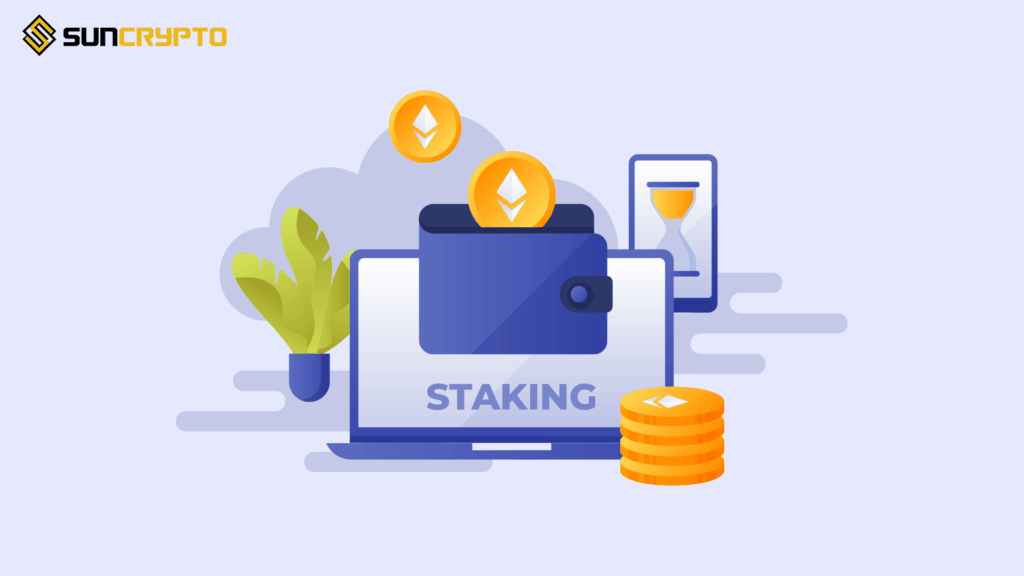
Crypto staking is a mechanism that allows cryptocurrency holders to earn rewards by participating in the security and operation of a blockchain network. It is the core function of blockchains utilizing the Proof-of-Stake (PoS) consensus model, and it’s often compared to earning interest in a savings account, making it a popular method for generating passive income from otherwise idle digital assets.
On exchanges like SunCrypto, staking provides a simplified way for Indian investors to put their crypto holdings to work and receive rewards directly within their centralized exchange wallet.
How does Crypto Staking work?
Staking is integral to the Proof-of-Stake (PoS) consensus mechanism, which is a more energy-efficient alternative to Bitcoin’s Proof-of-Work (PoW).
- The Validator Role: Instead of miners competing with computing power, PoS relies on validators (users who have staked their coins) to verify new transactions and add them as blocks to the blockchain.
- The Stake as Collateral: Users “stake” (lock up) a specific amount of the network’s native cryptocurrency as collateral. This stake serves as a financial incentive for the validator to behave honestly.
- Selection and Reward: The PoS protocol randomly selects a validator to propose and validate the next block. The size of the stake generally increases the probability of selection. In return for successfully securing the network, the validator earns a staking reward, typically in the form of newly minted cryptocurrency or transaction fees.
- Slashing: If a validator attempts to cheat or consistently fails to maintain their node (goes offline), the protocol can enforce a penalty called slashing, confiscating a portion of their staked crypto. This mechanism ensures network integrity.
When you stake on a centralized exchange like SunCrypto, the exchange handles all the complex technical requirements of running the validator node for you.
Types of Crypto Staking
The method you choose for staking determines the technical complexity, capital requirement, and level of control you maintain over your assets.
Risks associated with Crypto Staking
While staking is often promoted as a low-effort passive income source, it is not risk-free. These risks apply regardless of whether you are staking independently or using a centralized platform like SunCrypto.
1. Market Risk (Price Volatility)
- The biggest risk. Rewards are paid out in the staked cryptocurrency. If you earn a 10% APY, but the market price of the staked coin drops by 20% during the year, the overall value of your investment (staked coins + rewards) has decreased in fiat terms (e.g., in INR).
2. Liquidity and Lock-up Risk
- Many staking protocols require a lock-up period (from a few days to several weeks) during which your staked assets cannot be sold or transferred.
- The Danger: If the market experiences a sudden, sharp crash, you are unable to sell your staked tokens until the lock-up period ends, potentially leading to greater losses. Even after a lock-up ends, many networks have an unstaking period (or cool-down period) before the funds are accessible.
3. Slashing and Validator Risk
- This risk is primarily managed by a platform like SunCrypto, but it still exists at the network level. If the chosen validator acts maliciously or experiences technical failures, the network can impose a slashing penalty, resulting in the loss of a portion of the staked funds.
- When staking on a CEX like SunCrypto, you are trusting the exchange to manage this risk efficiently and reimburse you if a loss occurs due to their fault.
4. Smart Contract Risk (for Delegated/Liquid Staking)
- If you choose delegated or liquid staking, the staking mechanism is governed by a smart contract. A bug or vulnerability in that code could be exploited by a hacker, leading to the loss of staked funds.
Disclaimer: Crypto products & NFTs are unregulated and can be highly risky. There may be no regulatory recourse for any loss from such transactions.