
Historically, Uniswap was criticized as a “governance-only” asset with no direct link to the protocol’s massive trading volume. However, the landscape shifted in late 2025 with the activation of the “Fee Switch.” As of early 2026, UNI has transitioned into a deflationary, value-accruing asset, fundamentally changing its valuation models from speculative “meme-governance” to cash-flow-based analysis.
Current Market Snapshot (February 2026)
- Current Price: $3.31 – $5.50 (Consolidation phase)
- All-Time High: $44.97 (May 2021)
- Key Catalyst: Uniswap V4 “Hooks” and the UNIfication burn mechanism.
Breaking the $11 Resistance of Uniswap
For UNI to rally toward the $15 mark, it must first reclaim the psychological and technical barrier at $11.00.
1. The Consolidation Breakout (2026)
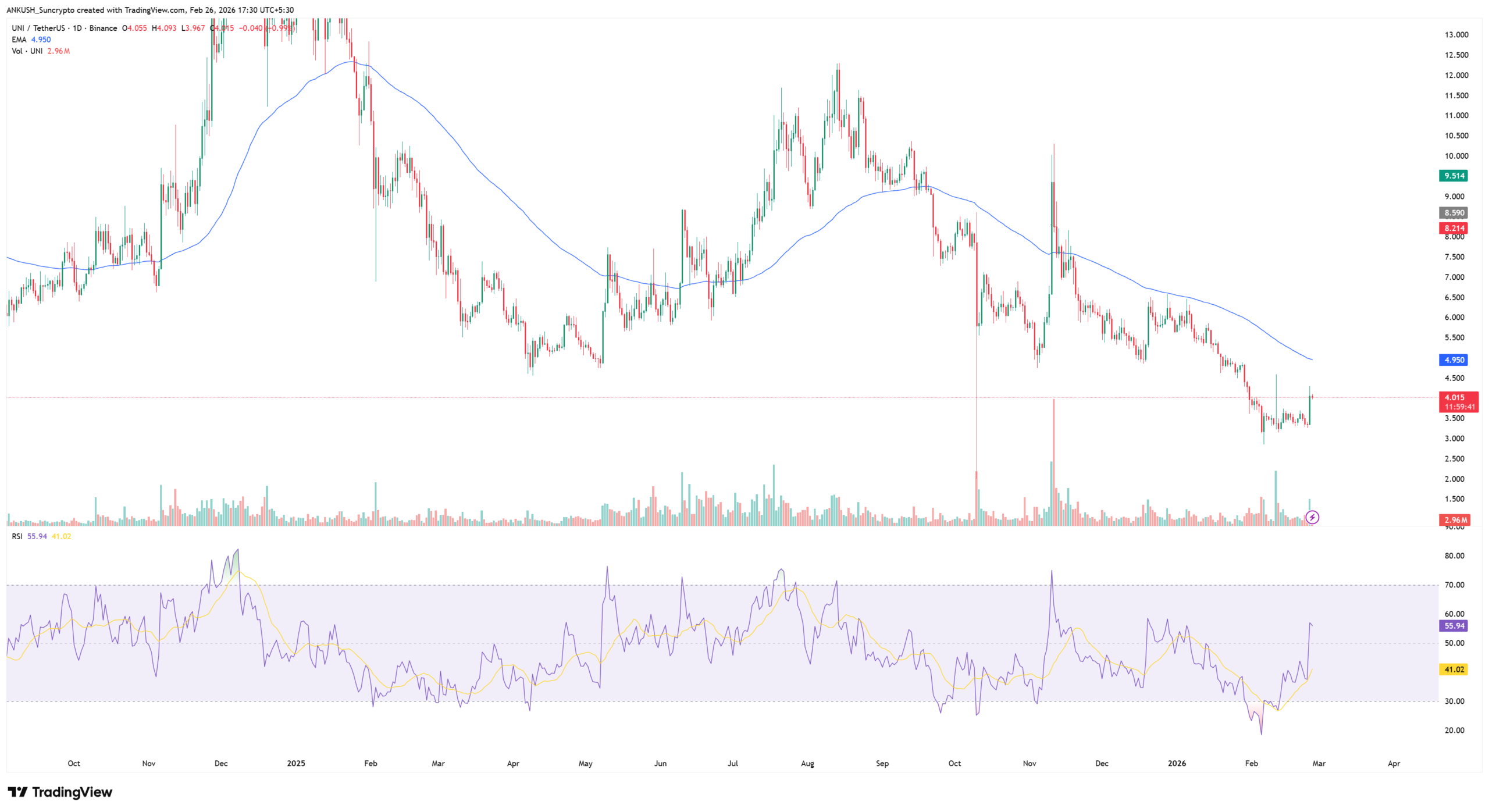
As of Q1 2026, UNI is showing a bullish divergence on the weekly RSI. While the price has been suppressed due to broader macro “tariff shocks,” the selling momentum is exhausted.
- Support: $3.17 is the “hard floor.”
- Immediate Resistance: $6.00 and $7.90.
- The $11.00 Trigger: This level represents the 200-day Moving Average on the macro scale. A daily close above $11.00 likely signals the end of the post-2025 “winter” and opens the path to $15.00.
2. The Path to $15.00 (2026–2027)
Reaching $15 requires a sustained recovery in DeFi TVL (Total Value Locked). Analysts predict that if Uniswap maintains its 37% market share of all DEX volume, the “Fee Switch” will result in the burning of approximately 4 million to 5 million UNI per year. This programmatic scarcity is expected to drive the price toward $15.50 by mid-2027.
Uniswap Long-Term Price Predictions: 2026–2030
The following table outlines the projected price ranges based on current burn rates and DeFi adoption cycles.
| Year | Potential Low | Potential High |
Key Driver |
|
2026 |
$3.30 |
$12.10 |
V4 “Hooks” adoption & fee switch momentum. |
|
2027 |
$7.00 |
$18.50 |
Institutional DeFi pilots & “Unichain” sequencer revenue. |
|
2028 |
$10.00 |
$26.00 |
Full integration of Real-World Assets (RWAs) on-chain. |
|
2029 |
$15.50 |
$45.00 |
Global regulatory clarity (Clarity Act impact). |
|
2030 |
$19.00 |
$75.00+ |
Uniswap becomes the “NASDAQ of DeFi.” |
Why Uniswap Could Outperform?
The V4 “Singleton” Efficiency
Unlike V3, where every pool was a separate contract, Uniswap V4 uses a “Singleton” contract. This reduces the cost of creating a new liquidity pool by 99.99%. In 2026, this is attracting high-frequency traders and “long-tail” token projects that previously found Ethereum gas fees too expensive.
The UNIfication Burn Mechanism
The “UNIfication” proposal passed in November 2025 has effectively turned the protocol into a “buyback-and-burn” machine.
- Protocol Revenue: Estimated at ~$26M annualized.
- Supply Reduction: ~10% of the total supply was burned in a one-time treasury event, with ongoing daily burns now active.
Regulatory “Safe Harbor”
With the US expected to introduce a clear crypto framework in 2026, Uniswap’s decentralized nature makes it a prime candidate for institutional “permissioned” liquidity pools (similar to Aave Arc).
Risk Factors to Monitor
- SEC Scrutiny: Despite the “Fee Switch,” the debate over whether UNI is a “security” remains a headline risk.
- L2 Competition: While Uniswap dominates, specialized DEXs on Base or Solana could eat into market share if Uniswap’s multi-chain deployment lags.
- Macro Liquidity: If global interest rates remain “higher for longer” through 2027, the capital available for DeFi yield farming may stay suppressed.
Final Verdict
UNI could break $11 as, technical indicators suggest a recovery is building, and the fundamental shift to a value-accruing model provides a “floor” that didn’t exist in previous cycles. A rally toward $15.00 is a realistic target for the second half of 2026 or early 2027 as the burn mechanism begins to meaningfully impact circulating supply.
Disclaimer: Crypto products & NFTs are unregulated and can be highly risky. There may be no regulatory recourse for any loss from such transactions.