
As of February 3, 2026, Bittensor (TAO) is navigating a pivotal phase in its lifecycle. Having recently completed its first-ever halving in December 2025, the network is transitioning from a period of high inflation to one of increasing scarcity.
Here is a detailed analysis and price prediction for TAO through 2030.
Current Market Context (Feb 2026)
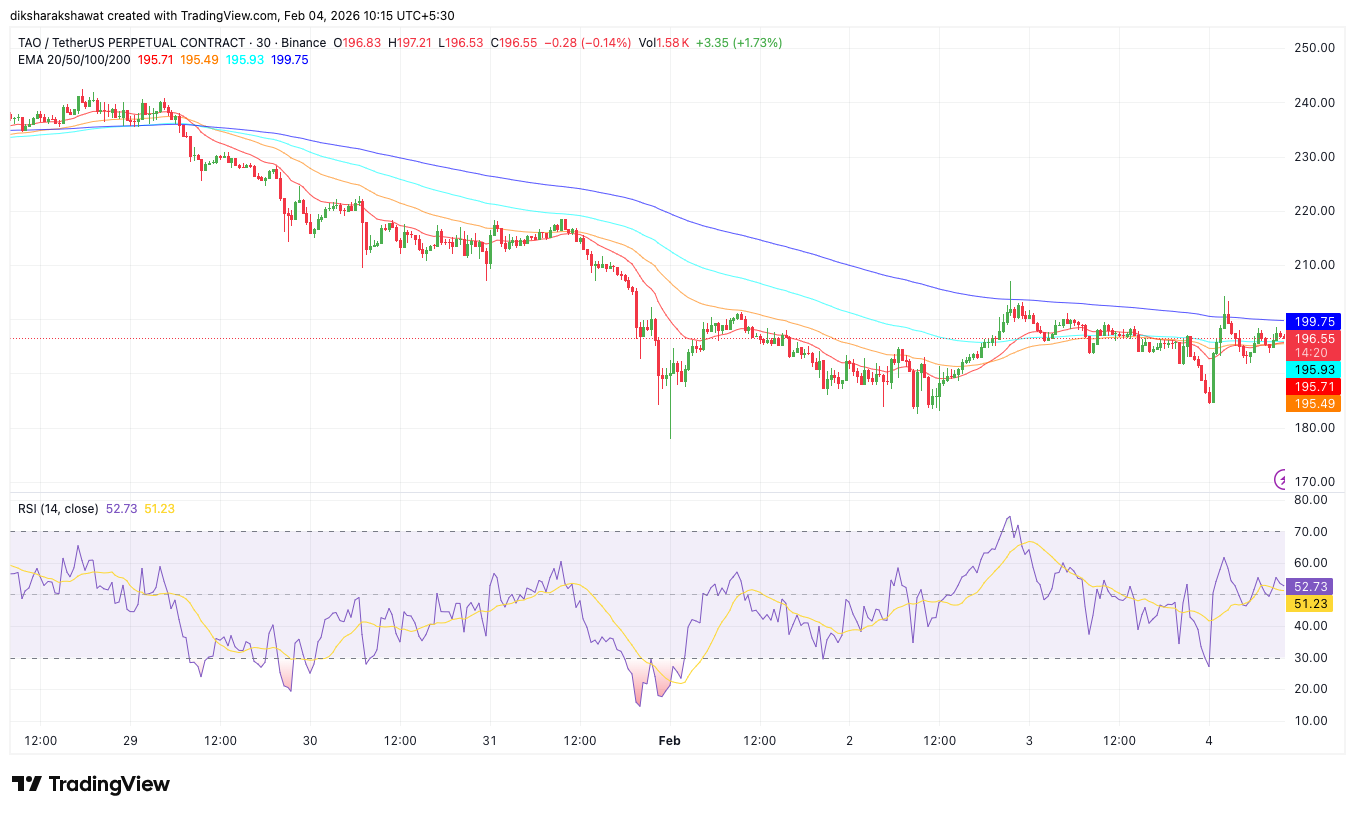
TAO is currently trading between $190 and $240, with a market capitalization of approximately $2.2 billion. The sentiment is a “tug-of-war”: while short-term technicals remain bearish following a late-2025 drawdown, institutional accumulation is at an all-time high.
- Circulating Supply: ~9.6 million TAO (out of 21 million max).
- The Halving Effect: Daily emissions were slashed from 7,200 to 3,600 TAO in December 2025.
- Institutional Presence: Major players like Digital Currency Group (DCG) and Grayscale (with a TAO ETF filing) are providing a structural “floor” for the price.
Price Predictions: 2026–2030
Based on current supply dynamics, these predictions are based on favorable market circumstances. The result may differ in the future, so DYOR before investing in any crypto, subnet expansion, and analyst consensus. Here are the projected price ranges:
|
Year |
Potential Low | Average Price |
Potential High |
|
2026 |
$230 | $580 | $1,160 |
| 2027 | $415 | $590 |
$1,750 |
|
2028 |
$770 | $1,250 | $2,600 |
| 2029 | $1,300 | $2,100 |
$3,900 |
|
2030 |
$1,970 | $3,900 | $5,900 |
2026 Outlook: The Year of Absorption
For the remainder of 2026, the market must “digest” the reduced emissions.
- Bull Case ($1,000+): Driven by the potential approval of a Spot TAO ETF and the roadmap expansion from 128 to 256 active subnets.
- Bear Case ($230): Persistent “risk-off” sentiment in the broader crypto market or regulatory hurdles regarding decentralized AI models.
Key Drivers for TAO’s Value
Several fundamental catalysts are expected to influence the price over the next four years:
1. Subnet Utility & Staking
Every new subnet (specialized AI networks for text, vision, or compute) requires TAO to be staked and locked. As the ecosystem grows toward the 256-subnet cap, a massive portion of the circulating supply will be effectively removed from the open market, creating a “supply squeeze.”
2. “Dynamic TAO” (dTAO)
The transition to Dynamic TAO means rewards are no longer fixed; they are distributed based on a subnet’s actual performance and utility. This incentivizes “blue-chip” subnets that generate real-world value, attracting more enterprise-level users.
3. The “Bitcoin of AI” Narrative
With a hard cap of 21 million tokens and a halving schedule identical to Bitcoin, TAO is increasingly viewed as the “digital commodity” of the intelligence age. As AI becomes the dominant global industry, TAO is positioned as the decentralized settlement layer for that intelligence.
Risks to Consider
- Centralized Competition: If OpenAI, Google, or Meta produce closed-source models that significantly outperform decentralized subnets, the demand for Bittensor’s network could stall.
- Technical Complexity: The “Dynamic TAO” and validation mechanics are complex; any bugs or incentive failures could lead to validator exits.
- Volatility: TAO historically experiences 40–60% drawdowns. It remains a high-beta asset that reacts violently to Bitcoin’s movements.
Note: These projections are based on current market data and technical trends. Cryptocurrency investments carry high risk; always conduct your own research.
Disclaimer: Crypto products & NFTs are unregulated and can be highly risky. There may be no regulatory recourse for any loss from such transactions.