
There’s a moment every new trader experiences. They’ve finally understood the concept of stop loss, sell high, buy back low, and take profit in the futures market. It seems logical. Then they go to set their stop loss, and something breaks inside their brain.
Most beginners make the same mistake when they place their very first short trade.
They price the asset at $100 and consider, “My stop loss should be set at $80, consistent with my approach in a long position.” So they type $80 into the exchange. And the exchange simply does not allow it. It tells them the stop loss must be above $100, not below. The beginner is now confused?
Because in a short trade, your enemy is not the price going down; that is actually what you want. Your enemy is making the price go up.
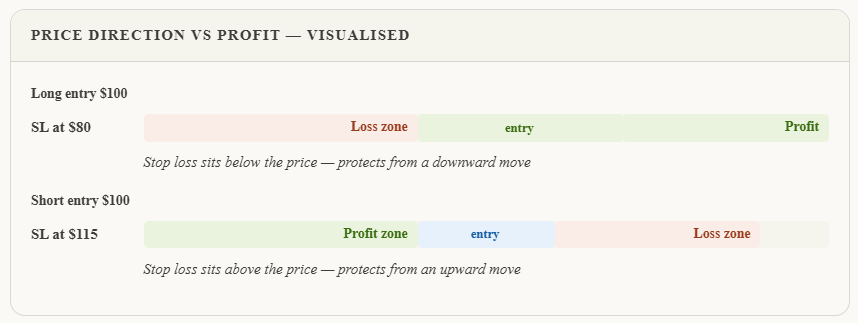
If you sold at $100 and the price shoots up to $130, you are in big trouble because you still have to buy it back to close your position, and now it costs you more. So your stop loss must sit above your entry, not below, to protect you from that upward move. The exchange knows this, and that is exactly why it rejects a stop loss placed below the entry on a short position.
This isn’t stupidity. It’s a deeply wired cognitive conflict. Understanding exactly why this confusion happens and why it is so persistent is the first step to trading shorts without second-guessing yourself at every position.
The long position is wired into your intuition
Human beings have been buying things their whole lives. When you buy a house, you want it to go up. When you buy a stock, you want it to go up. Every financial instinct you’ve ever developed is calibrated for the long direction. You own something, you want to protect it from going down, so you set a limit below your purchase price.
This is so intuitive it feels like gravity. Down equals danger. Stop loss goes below.
| Long position
You bought at: $100 Fear: Price drops Stop loss: Below entry — $80 Take profit: Above entry — $130 |
Short position
You sold at: $100 Fear: Price rises Stop loss: Above entry — $115 Take profit: Below entry — $70 |
What if the short position actually reverses?
When you short, you don’t own the asset — you owe it. This is the fundamental inversion that breaks people’s intuition. You borrowed sneakers, sold them for $100 cash, and now you owe someone a pair of sneakers regardless of what they cost at the time you return them.
Your profit and loss map is now a mirror image of what you’ve known your whole life. If the price goes down to $60, you buy them back cheap and profit $40. If the price goes up to $150, you still have to return them — and that now costs you $50 out of pocket.
The language problem makes it worse
Most trading interfaces use the same word, “stop loss,” for both directions. The term “stop loss” itself is neutrally named, but every mental image traders have built around it is anchored to the long side: a floor below you. When you’re short, that mental image actively misleads you.
It would be beneficial to completely reframe the definition. A stop loss is not a floor below your entry price. A stop loss is a point where your position becomes too painful to hold. For a long-term trader, that pain threshold is lower. For a short trader, that pain threshold is higher.

Take profit compounds the confusion
If the stop loss feels backwards, the take profit feels even stranger. A long trader places a take profit above their entry; they want the price to go to $130 so they can sell at a profit. Clean and obvious.
A short trader places a take profit below their entry. They sold at $100 and want to buy back at $60 to close the position at a profit. However, a “take profit” positioned below the current price appears, both visually and emotionally, similar to a stop loss. It’s sitting in the same psychological zone where the long trader’s danger lies.
“For the short seller, the price chart is read upside-down. Down is winning. Up is losing. Every label stays the same, but the emotional weight attached to each direction is swapped.”
Why even experienced traders slip up
This confusion isn’t limited to beginners. Experienced traders who primarily trade longs will still hesitate when sizing up a short position. The reason is context-switching cost. Your brain has thousands of hours of long-position pattern recognition built up. Switching to short mode requires consciously overriding that circuitry every single time, especially under time pressure when a position is moving fast.
Rewiring, not just remembering
The goal isn’t to memorize a rule (“shorts are reversed“). Rules are fragile under stress. The goal is to genuinely internalize the underlying logic: you owe an asset, your enemy is a rising price, and every protective tool you use is calibrated against that upward threat. Once that becomes instinctive, once you feel the danger in an upward candle when you’re short, the correct placement of both stop loss and take profit becomes as obvious as it is on the long side.
Until then, slow down, write the sentence, and set the levels using logic rather than instinct. Your account will thank you.
Disclaimer: Crypto products & NFTs are unregulated and can be highly risky. There may be no regulatory recourse for any loss from such transactions.