
This incredible Ethereum “time travel” event from February 2026 highlights the massive potential of early crypto adoption and the technical quirks of long-term storage. When an Ethereum wallet remains untouched for over a decade, its sudden movement creates a ripple effect across the entire blockchain ecosystem, serving as both a cautionary tale and a testament to the power of “Diamond Hands.”
The Awakening: A Decade of Dormancy
On February 16, 2026, a dormant Ethereum ICO (Initial Coin Offering) wallet reactivated after exactly 10.6 years of absolute silence. This wallet belongs to the “Genesis” era of Ethereum—a time when the network was nothing more than a bold experiment. The participant originally invested a mere $443 in 2014 to acquire 1,430 $ETH. At the time, ETH was priced at roughly $0.31 per coin.

Fast forward to 2026, and the value of this stash has ballooned to approximately $2.8 million. This represents a staggering 6,316x return on the initial capital. To put that in perspective, while traditional markets celebrate a 10% annual return, this “whale” achieved a life-changing fortune by simply doing nothing through multiple market cycles, including the 2017 bull run, the 2022 crash, and the subsequent recovery.
The Failed Move: A Lesson in “Gas”
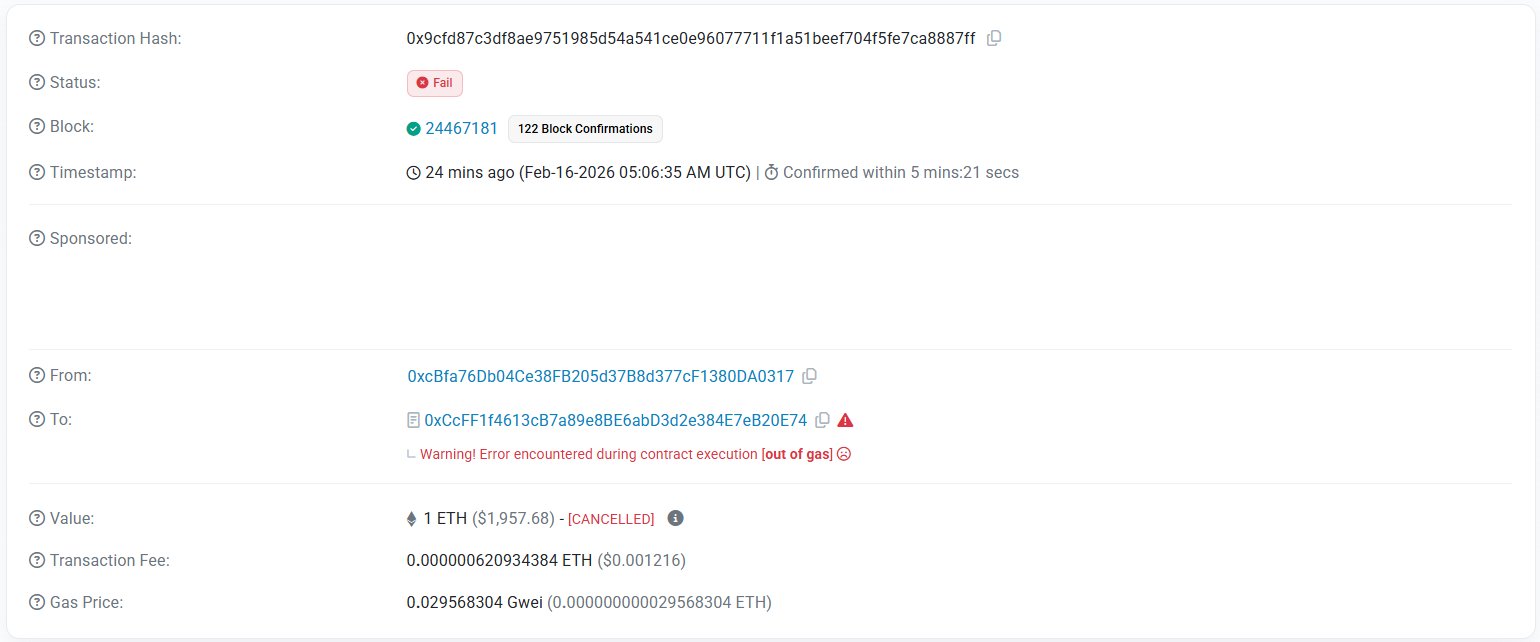
The “awakening” was marked by a curious technical hiccup. The owner attempted to transfer 1 $ETH to the Gemini exchange—a move often described as a “test transaction” to verify that the private keys still work and the destination address is active. However, the transaction failed.
The reason behind the failure was Insufficient Gas. “Gas” refers to the unit that measures the amount of computational effort required to execute operations on the Ethereum network. Even though the wallet holds millions of dollars in assets, the owner failed to allocate enough ETH to cover the base fee of the transaction. This proves that even “crypto OGs” can get rusty after a decade-long nap. In the 2026 landscape, where gas dynamics have shifted through numerous upgrades, navigating on-chain fees still requires a level of active technical knowledge that a decade of dormancy can dull.
Why This Matters: Market Psychology and On-Chain Security
The reactivation of such a significant wallet is never a quiet event. It was immediately flagged by blockchain trackers like Lookonchain, sending a clear signal to the market that a major “whale” is now active. This serves as a reminder that on the blockchain, privacy is limited; every move by a large holder is scrutinized by retail traders and institutional bots alike on platforms like SunCrypto.
Furthermore, the timing of this awakening—amidst a period of Extreme Fear where Bitcoin and Ethereum are testing critical support levels—sparks intense speculation. If the owner eventually decides to offload the full 1,430 $ETH, it could create localized selling pressure on exchanges like Gemini.
Ultimately, this event is a masterclass in the HODL strategy. Whether the holder was simply patient, lost their keys, or was legally incapacitated, their “Diamond Hands” turned a small $443 bet into a multi-million dollar empire.
Disclaimer: Crypto products & NFTs are unregulated and can be highly risky. There may be no regulatory recourse for any loss from such transactions.