
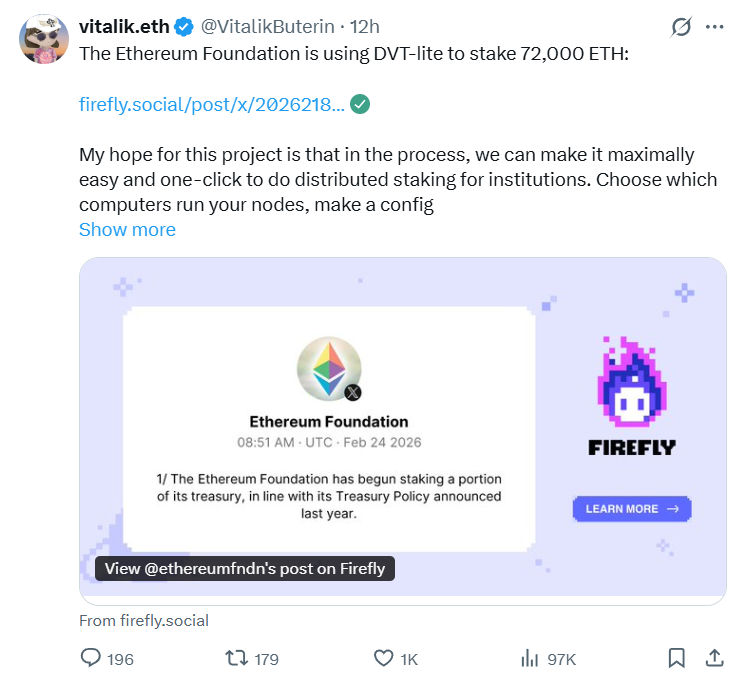
On March 9, 2026, Ethereum co-founder Vitalik Buterin announced that the Ethereum Foundation (EF) has officially begun staking 72,000 ETH (valued at approximately $140 million–$150 million) using a “DVT-lite” setup.
This project is a strategic move to model “institutional solo staking” and break the narrative that running secure, distributed infrastructure requires a fleet of professional DevOps engineers.
What is “DVT-lite”?
While standard Distributed Validator Technology (DVT) like Obol or SSV involves complex consensus layers between nodes, DVT-lite—specifically the combination of Dirk (distributed signer) and Vouch (multi-node validator client)—is designed for simplicity.
- The Goal: To allow a single entity (like an institution or a whale) to split their validator key across multiple machines or jurisdictions without the heavy overhead of a full DVT protocol.
- The Setup: It uses an “M-of-N” threshold signature scheme. Even if one node is hacked or goes offline, the validator remains active and secure.
- Infrastructure: The EF is intentionally using minority clients (like Nimbus or Lodestar) and a mix of self-managed hardware and hosted infrastructure to promote “client diversity,” a key security metric for Ethereum.
Vitalik’s Vision “One-Click” Institutional Staking
Vitalik’s post outlines a radical shift in how staking infrastructure should be deployed. He argues that the current “complexity” of staking is an “anti-decentralization” force.
- The “Anti-Professional” Stance: Vitalik directly challenged the idea that infrastructure must be “scary” or “professional.” He wants to lower the barrier so that any institution holding ETH can run their own nodes rather than delegating to centralized providers like Coinbase or Lido.
- The Deployment Model: He envisions a process where staking is as simple as:
- Downloading a Docker container or Nix image.
- Entering the same key into each node.
- The nodes automatically discover each other, handle the networking, and perform the Distributed Key Generation (DKG).
- Staking begins with zero manual configuration.
Why does this matter for the network?
By staking 72,000 ETH this way, the Ethereum Foundation is aiming to achieve several goals:
- Decentralization: Reducing the “Nakamoto Coefficient” (the number of entities needed to compromise the network) by encouraging institutions to solo-stake instead of using the same 3–4 massive pools.
- Client Diversity: By using Dirk and Vouch (which are not the dominant “Geth/Lighthouse” combo), the EF is protecting the network from a bug that could take down the majority of validators.
- Treasury Sustainability: The rewards from this 72,000 ETH will go directly back into the EF treasury to fund protocol research and ecosystem grants.
Direct Call to Action
Vitalik confirmed that he plans to adopt this “one-click” method for his personal staking soon. He is calling on other “ETH-holding institutions”—from treasury-holding startups to large investment funds—to stop “parking” their coins with third-party providers and start running their own distributed nodes to ensure the authority over the network remains highly decentralized.
Ethereum Foundation Staking Setup
|
Feature |
Details |
|
Amount Staked |
72,000 ETH |
|
Technology Stack |
DVT-lite (Dirk + Vouch) |
|
Strategy |
Multi-jurisdiction, Multi-cloud, Minority Clients |
|
Primary Goal |
One-click distributed staking for institutions |
| Deployment |
Docker / Nix-based automation |
Disclaimer: Crypto products & NFTs are unregulated and can be highly risky. There may be no regulatory recourse for any loss from such transactions.
What is the Ethereum Foundation (EF) actually doing?
The EF is staking roughly 72,000 ETH (approx. $140M–$150M) using a setup called DVT-lite. Instead of giving their ETH to a service like Lido or Coinbase, they are running their own nodes to earn native yield for the EF treasury while modeling “best practices” for other institutions.
Will this affect the price of ETH?
Symbolically, it’s a “buy signal” because the Foundation is locking away 72,000 ETH (approx. 38% of their liquid holdings) rather than selling it to pay for operations. They will now use the staking rewards (estimated at 2,000+ ETH per year) to fund grants and research, reducing their need to sell ETH on the open market.
Can I use this “DVT-lite” setup today?
The tools (Dirk and Vouch) are open-source and available now, but the “one-click” automated version Vitalik described is the current goal of the project. The EF’s deployment is the “test case” to prove this can be done easily at an institutional scale.