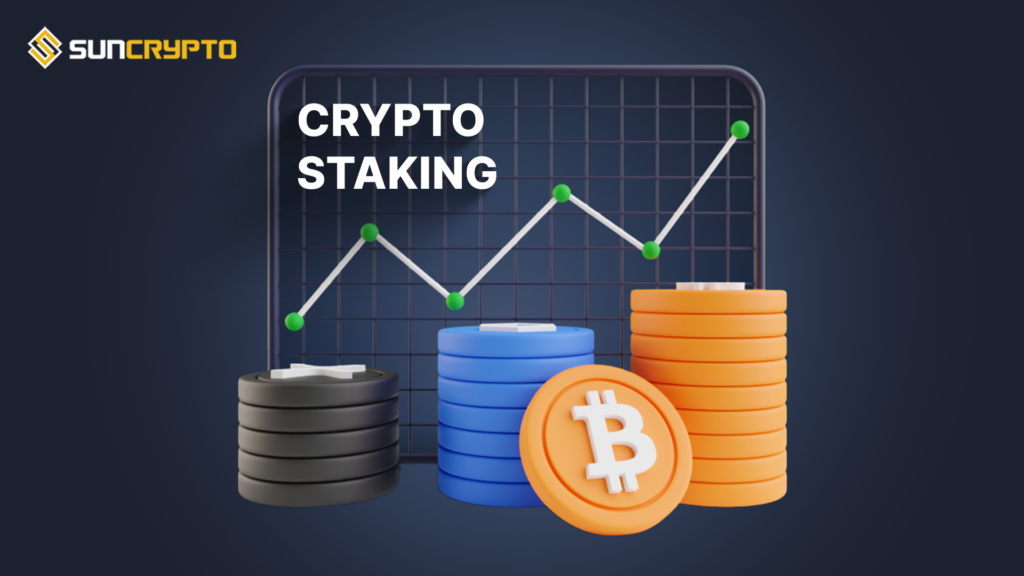
Crypto staking is a fundamental process in the decentralized world, offering cryptocurrency holders a way to earn passive rewards while actively securing and supporting the operation of a blockchain network. It is the core engine of the Proof-of-Stake (PoS) consensus mechanism, making it a crucial concept for anyone engaging with DeFi and Web3 assets on platforms like SunCrypto.
Staking has evolved beyond just securing blockchains; it is now an essential element integrated with oracles and the wider DeFi landscape.
Crypto Staking and the Blockchain
At its simplest, crypto staking is the act of locking up a quantity of cryptocurrency to help validate transactions and maintain the integrity of a blockchain.
The Mechanism: Proof-of-Stake (PoS)
- Collateral: Unlike Proof-of-Work (PoW) blockchains (like pre-merge Bitcoin) that use computational power (mining), PoS uses the staked cryptocurrency as collateral to incentivize honest behavior.
- Validators: Stakers become, or delegate their coins to, validators. These validators are responsible for proposing and voting on new blocks of transactions to be added to the chain.
- Rewards: When a validator successfully verifies a block according to the network rules, they are rewarded with newly minted tokens and transaction fees. This is the APY (Annual Percentage Yield) that stakers earn.
- Slashing: To ensure honesty, the network implements a strict penalty known as slashing. If a validator attempts to cheat (e.g., validate conflicting information) or fails due to extended downtime, a portion of their staked collateral is destroyed (slashed).
For users on SunCrypto, the exchange manages the technical complexity of running a validator node and handles the risk of slashing due to technical errors, simplifying the experience significantly.
Crypto Staking’s Role in DeFi
In the broader DeFi ecosystem, staking takes on various forms beyond simple blockchain consensus, all enabled by smart contracts.
| Staking Type | Primary Purpose | Rewards Source |
| Network Staking (PoS) | Secure the core blockchain by validating blocks. | Newly minted tokens and transaction fees. |
| Liquidity Pool (LP) Staking | Provide capital for token swaps on a DEX (e.g., Uniswap). | Transaction fees paid by traders using the pool. |
| Governance Staking | Earn voting power to decide on the future direction and upgrades of a protocol (e.g., a DAO). | Governance tokens or a share of protocol revenue. |
In DeFi, staking your assets contributes to the liquidity and stability of services like decentralized lending and borrowing, creating the foundation for the entire decentralized financial system.
The Connection to Oracles
While blockchains are excellent at recording information securely, they cannot access real-world data (like the price of USD, the weather, or election results) on their own. This is the job of a blockchain oracle.
Staking is integrated into many decentralized oracle networks (like Chainlink) to ensure the data they feed to smart contracts is reliable and honest.
- Oracle Staking: Users stake the oracle network’s native token as collateral. They are then rewarded for providing accurate, timely external data to smart contracts.
- Incentive Mechanism: If an oracle node provides fraudulent or incorrect data that is used by a smart contract (e.g., a DeFi lending protocol), the collateral staked by the node can be slashed.
- Why it Matters: Staking in oracle networks ensures that complex financial contracts on the blockchain (which rely on external data, like liquidating a loan if the collateral price drops) are based on verifiable and uncorrupted real-world information.
Key Risks and Benefits of Crypto Staking
For investors using SunCrypto’s staking services, the value proposition is clear, but the risks must be acknowledged.
Benefits
- Passive Income: Earn rewards on crypto assets you plan to HODL (hold long-term).
- Compounding: Rewards are often automatically restaked, leading to exponential growth over time.
- Network Participation: Contribute directly to the security and decentralization of the blockchain ecosystem.
Risks
- Price Volatility: The value of your staked crypto can drop (in INR terms) more than the value of the rewards earned, leading to a net loss.
- Lock-up Periods: Assets are typically locked during the staking and unbonding (unstaking) periods, meaning they cannot be quickly sold during a market crash.
- Slashing: Though mitigated by using a reliable platform like SunCrypto, the risk of losing collateral due to validator misconduct or downtime is inherent to the PoS mechanism.
Crypto staking on SunCrypto provides an accessible path to earning yield, combining the security and simplicity of a centralized exchange with the passive income potential of the core decentralized blockchain technology.
Disclaimer: Crypto products & NFTs are unregulated and can be highly risky. There may be no regulatory recourse for any loss from such transactions.