
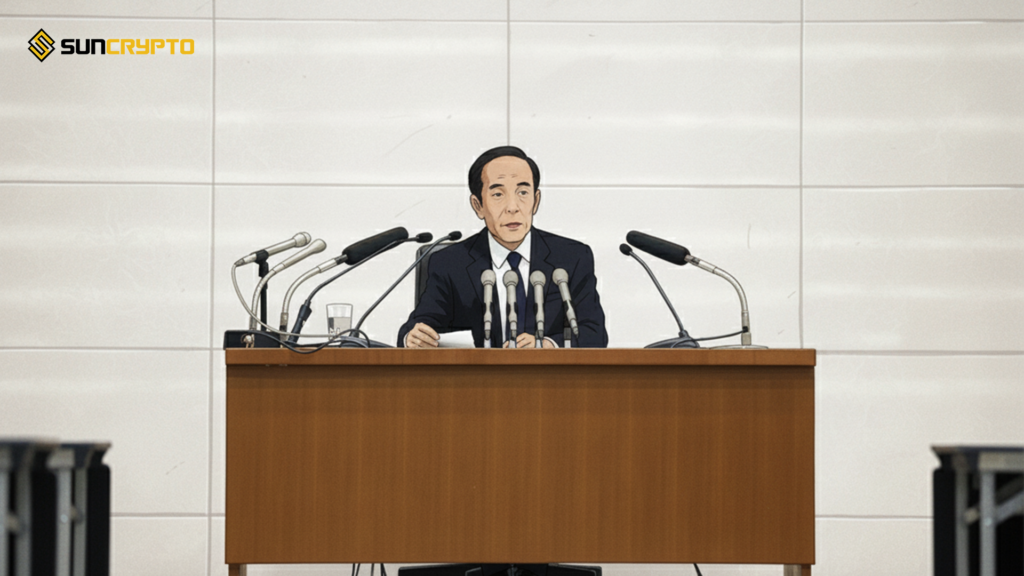
In a historic move, the Bank of Japan (BoJ) raised interest rates to 0.75% on December 19, 2025.
The Bank of Japan (BOJ) raised its key policy rate 25 bps to 0.75%, its highest level since September 1995. This decision marks the highest Japan hike rates seen in 30 years (since 1995) and signals a definitive end to the country’s decades-long era of ultra-loose monetary policy.
The Bank of Japan’s (BoJ) decision on December 19, 2025, to hike rates to 0.75%—a 30-year high—is a “butterfly effect” moment for global markets. While it happens in Tokyo, the ripples are hitting Dalal Street and the crypto markets hard due to the unwinding of the Yen Carry Trade.
What is yen carry trade?
A currency carry trade is a strategy where an investor borrows money in a low-interest-rate currency and invests it in a country offering higher interest rates.
For example, assume interest rates in Japan are 0%, while interest rates in the US or Europe are 5%. An investor can borrow Japanese yen from a Japanese bank at nearly zero interest. The borrowed yen is then converted into dollars (or euros) and deposited in a foreign bank that offers a 5% return.
By doing this, the investor earns interest on the higher-yielding currency while paying little to no interest on the borrowed yen. In theory, this allows the investor to generate a 5% profit, based purely on the difference between Japanese and overseas interest rates.
Key Takeaways from the Japan Hike Rates
- The BoJ unanimously voted to increase the short-term policy rate by 25 basis points, moving it from 0.5% to 0.75%.
- The reason is that Governor Kazuo Ueda cited growing confidence in a “virtuous cycle” between rising wages and prices. Core inflation has remained steady around 3%, and corporate profits have stayed high enough to support further wage hikes in 2026.
- The BoJ signaled it is ready for further hikes if economic projections are met. Governor Ueda noted that even at 0.75%, “real interest rates remain significantly negative,” meaning the policy is still technically supportive of growth, just “less of an accelerator” than before.
Timeline of Japan Hike Rates 2025
|
Date |
Action | New Rate |
Context |
|
January 2025 |
Hike |
0.50% |
First major move of the year; highest rate in 17 years at the time. |
|
Mar–Oct 2025 |
Hold |
0.50% |
A period of observation to see if inflation would stabilize after the January hike. |
|
Dec 19, 2025 |
Hike |
0.75% |
Reaches a 30-year high; telegraphed by Ueda in early December. |
Why Japan Hike Rates Matters Globally
- The “Yen Carry Trade”: For years, investors borrowed Yen at 0% to invest in higher-yielding assets elsewhere (like the US or India). As Japan’s rates rise while the US Federal Reserve begins cutting, this trade is “unwinding,” which can cause significant volatility in global stock markets.
- JGB Yields: The yield on the 10-year Japanese Government Bond (JGB) has recently pushed past the 2% mark, a level unseen since the mid-2000s, attracting Japanese capital back home from overseas bond markets.
- Currency Impact: While a rate hike usually strengthens the Yen, the market has largely “priced this in.” The focus now is on how fast Japan will move toward 1.0% in 2026.
Japan Hike Rates Impacting Indian Markets
For the Indian market, the BoJ hike is a liquidity drain rather than a fundamental economic shift.
- FII Outflows: Japan is a massive source of global liquidity. For years, investors borrowed cheap Yen to invest in high-growth markets like India. As Yen borrowing costs rise, Foreign Institutional Investors (FIIs) are pulling capital out of Indian equities to pay back Yen-denominated debt.
- Mid-cap Vulnerability: Interestingly, nearly 25% of Yen-funded inflows into India have historically targeted mid-cap funds. This makes the mid-cap segment more sensitive to Japanese policy shifts than the Nifty 50.
- The Rupee (INR): As the Yen strengthens against the Dollar, the Rupee often faces indirect pressure. If the Dollar-Yen pair (USD/JPY) drops too sharply, it can trigger broad-based emerging market currency volatility.
💱 The USD/JPY Exchange Rate
The BoJ hike has turned the Yen from a “funding currency” into a “target currency.”
- The Strengthening Yen: Immediately following the hike, the Yen surged. Historically, when the BoJ moves hawkishly, USD/JPY tends to trend lower (meaning the Yen is getting stronger).
- The “Unwind” Trigger: The danger zone for the carry trade is a strengthening Yen. If an investor borrowed Yen at 155 but has to pay it back when it’s at 145, their profit on Indian or US stocks is wiped out by the currency loss alone. This is what’s forcing the current market sell-off.
Impact of Japan Hike Rates on the Crypto Market
Crypto is often the “canary in the coal mine” for global liquidity shocks.
- The “BoJ Dip”: Historically, every major BoJ hike in 2024 and 2025 (March, July, and January) was followed by a 20–30% drawdown in Bitcoin.
- De-leveraging: High-leverage traders often use “cheap” capital to fund crypto positions. As Japan tightens, this “cheap” money disappears. We saw Bitcoin drop toward the $84,000–$86,000 range in mid-December as traders front-ran the BoJ decision.
- Liquidity Squeeze: Unlike the US Fed, which is currently in a cutting cycle, the BoJ is the only major central bank “tightening” at the end of 2025. This creates a “liquidity vacuum” that hits speculative assets like Altcoins even harder than Bitcoin.
The most interesting part of the Dec 19 hike isn’t the rate itself—it’s the market’s reaction. The Yen actually weakened initially because the BoJ didn’t promise a ‘forceful’ path for 2026. This creates a dangerous ‘calm before the storm’ for crypto and equity futures. If the Yen starts a sharp recovery in Jan 2026, expect a massive margin call across the board.
SunCrypto analyst said, “Japan’s 30-year-high rate hike is accelerating the unwinding of the Yen carry trade—tightening global liquidity and increasing near-term volatility across equities and crypto markets.”
Disclaimer: Crypto products & NFTs are unregulated and can be highly risky. There may be no regulatory recourse for any loss from such transactions.