

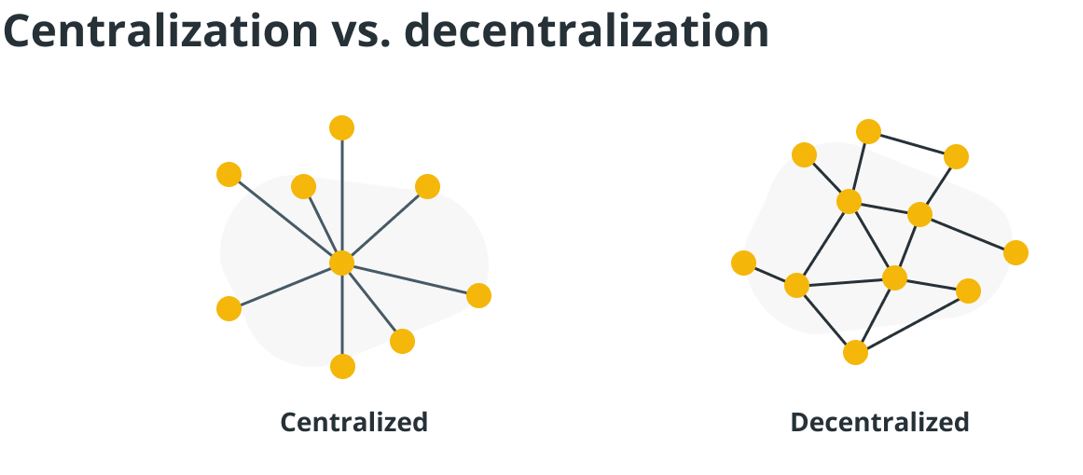
The Nakamoto Coefficient is a key metric used to measure the level of decentralization in a blockchain network. While decentralization is a foundational principle of blockchain technology—aimed at distributing control and decision-making across multiple participants instead of concentrating it in a single authority—it is not a fixed attribute. Unlike centralized systems where one entity governs all operations, decentralized networks enhance security, transparency, and fault tolerance by spreading control. However, the degree of decentralization can vary across different networks and evolve. This is where the Nakamoto Coefficient becomes crucial, offering a quantifiable way to assess how decentralized a blockchain truly is. Let’s explore how this metric is calculated and why it holds such importance in the blockchain ecosystem.
What is the Nakamoto Coefficient?
The Nakamoto Coefficient is a measure that indicates the degree of decentralization in a blockchain network. It is the smallest number of independent actors—validators, miners, or node operators—needed to collude and interfere with the functioning of the network.
Named after Bitcoin’s pseudonymous founder Satoshi Nakamoto, the Nakamoto Coefficient was launched in 2017 by ex-Coinbase CTO Balaji Srinivasan. The higher the Nakamoto Coefficient, the more decentralized and secure the network is, while a lower coefficient means that fewer parties control the network, making it susceptible to centralization threats.
For instance, a blockchain with a Nakamoto Coefficient of 1 would be extremely centralized because one entity would be able to control the network. On the other hand, a coefficient of 10 implies that at least 10 independent entities need to conspire to compromise the network, with a higher measure of decentralization.
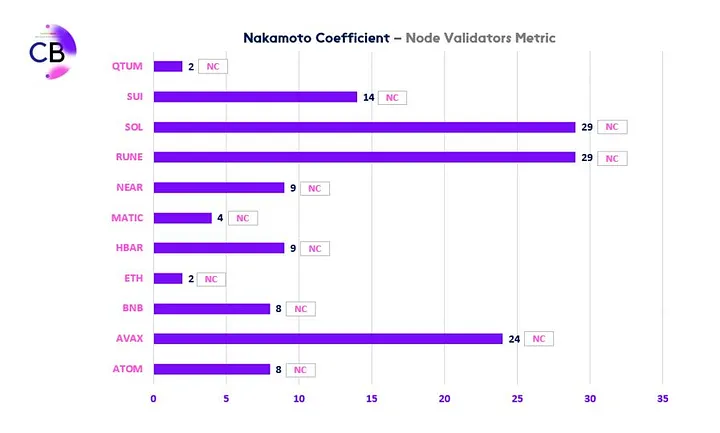
Given below are the Nakamoto Coefficients of some of the major blockchain networks
Why is the Nakamoto Coefficient Important?
The Nakamoto Coefficient is an important measure of blockchain security and governance. It indicates the distribution of power in a network and aids in determining its robustness. The main advantages are:
- Improved Security: Decentralized networks with strong Nakamoto Coefficient are resistant to attacks because it is difficult for a fraction to take over.
- Improved Transparency: Transactions stay transparent to every participant, fostering fairness and confidence.
- Improved Fault Tolerance: A decentralized network can continue even when nodes break down, resulting in higher robustness against failures.
How is the Nakamoto Coefficient Calculated?
Calculating the Nakamoto Coefficient involves analyzing the distribution of control among key network participants. The process includes:
- Identifying Key Actors: Identify the significant actors, i.e., mining pools, validators, or node operators.
- Evaluating Control Distribution: Quantify the control each actor exercises over the network (e.g., hashrate distribution in PoW blockchains or stake ownership in PoS blockchains).
- Calculating the 51% Threshold: Order entities by control percentage and tally their influence until the total sum exceeds 51%. The quantity of entities to achieve this sum is the Nakamoto Coefficient.
Let us understand it better with the help of the following example:
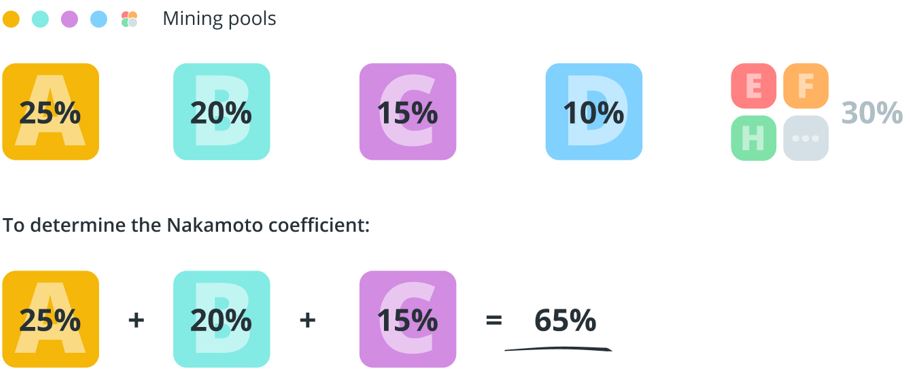
Consider a PoW blockchain with the following mining pool distribution:
- Mining Pool A: 25%
- Mining Pool B: 20%
- Mining Pool C: 15%
- Mining Pool D: 10%
- Others: 30%
To determine the Nakamoto Coefficient:
- Pool A (25%) + Pool B (20%) = 45%
- Pool C (15%) increases the total to 65%, surpassing the 51% threshold.
Thus, the Nakamoto Coefficient is 3, meaning collusion among these three pools could compromise the network’s integrity.
What Are the Limitations of the Nakamoto Coefficient?
While the Nakamoto Coefficient is a useful metric, it has several limitations:
- Static Nature: It captures a snapshot at one point in time, but not the dynamic changes in network involvement.
- Focus on Subsystems: The measure primarily assesses validators or miners, neglecting other aspects of decentralization such as node spread and software variance.
- Consensus Mechanism Differences: Various blockchains employ varying consensus mechanisms, so comparisons cannot be made.
- External Factors: Market changes, technology, and government regulations may impact decentralization but are not presented in the Nakamoto Coefficient.
Conclusion
The Nakamoto Coefficient is a critical indicator of blockchain decentralization, providing information on security, transparency, and robustness. A higher Nakamoto Coefficient represents an increasingly decentralized and secure network, while a lower coefficient indicates concerns related to centralization threats. However, it must not be the only way of measuring decentralization—governance models, geographical node distribution, as well as external regulations, all have their part to play.
Disclaimer: Crypto products and NFTs are unregulated and can be highly risky. There may be no regulatory recourse for any loss from such transactions. All content provided is for informational purposes only, and shall not be relied upon as financial/investment advice. Opinions shared, if any, are only shared for information and education purposes. Although the best efforts have been made to ensure all information is accurate and up to date, occasionally unintended errors or misprints may occur. We recommend you do your own research or consult an expert before making any investment decision. You may write to us at help@suncrypto.in.