
The crypto market is a rollercoaster of opportunities, where even a small movement can lead to significant gains—or losses. What if you could tap into those market swings without committing a large capital or worrying about liquidation risks? This is where Leveraged Tokens come into play.
Unlike traditional trading methods, leveraged tokens offer a simplified way to multiply your returns. Imagine investing ₹10,000 in a 3x leveraged token tied to Bitcoin. If Bitcoin rises by just 1%, your investment grows by 3%, unlocking potential profits with a fraction of the complexity of margin trading. Better yet, there’s no risk of being liquidated, even in volatile conditions.
In this blog, we’ll break down everything you need to know about leveraged tokens—how they work, their advantages and pitfalls, and whether they’re the right fit for your crypto strategy. Ready to explore this powerful trading tool? Let’s get started!
What are Leveraged Tokens?
Leveraged tokens are a specialized type of cryptocurrency derivative designed to amplify your exposure to the price movements of an underlying asset, such as Bitcoin (BTC) or Ethereum (ETH). Unlike traditional leveraged trading, which requires margin and collateral, leveraged tokens simplify the process by embedding leverage directly into the token.
Each leveraged token represents a collection of perpetual contract positions on the underlying asset, maintaining a fixed leverage ratio—commonly 2x, 3x, or even higher. For example, if a 3x leveraged token tracks Bitcoin and Bitcoin’s price increases by 1%, the token’s value rises by 3%. Conversely, if Bitcoin drops by 1%, the token’s value decreases by 3%. This mechanism allows investors to capitalize on market movements without engaging in the complexities and risks of managing margin trades.
One of the standout features of leveraged tokens is that they are perpetual products without an expiry date, meaning they do not risk being liquidated like traditional leveraged positions. Additionally, their price cannot fall to zero, offering an added layer of security. These tokens can be traded on the secondary market or redeemed directly in the primary market, offering flexibility to investors.
What Are The Working Mechanism of Leveraged Tokens?
Leveraged tokens operate through a combination of algorithms and a rebalancing mechanism to deliver amplified exposure to an underlying cryptocurrency’s price movements. These tokens aim to provide a fixed or variable leverage ratio, such as 2x, 3x, or even 4x, without requiring users to engage in traditional margin trading.
The core functionality of leveraged tokens lies in rebalancing. This process adjusts the token’s exposure daily (or during significant price swings) to maintain the intended leverage level.
For example, a 3x leveraged token tied to Bitcoin will aim to triple the daily percentage change of Bitcoin’s price. If Bitcoin’s price rises by 5%, the token’s value will increase by 15%. Conversely, a 5% drop in Bitcoin’s price will result in a 15% decline in the token’s value. The rebalancing mechanism ensures that the leverage ratio remains consistent, even in volatile markets.
Rebalancing works differently depending on the platform. Typically, it happens at a fixed time each day, such as 2 AM, or when market conditions trigger significant price movements (e.g., over 10%). During rebalancing, profits are reinvested if the price rises or positions are sold to mitigate losses if the price drops.
These tokens are ideal for one-sided, trending markets and not suitable for sideways or highly volatile markets due to potential decay in value caused by frequent rebalancing. Also, understanding the fees and platform-specific rules is crucial when trading leveraged tokens.
Difference Between Leveraged Tokens & Other Trading Options
Understanding the unique features of leveraged tokens compared to other trading options like margin trading, futures trading, and spot trading is essential for selecting the right investment strategy based on your risk appetite and market conditions. Here’s a detailed comparison:

Difference between Leveraged Tokens and Margin Trading.
Leveraged Tokens:
- Pre-packaged, tokenized products provide leveraged exposure to an asset.
- No margin accounts or collateral are required.
- No risk of liquidation due to automated rebalancing mechanisms.
- Leverage is passively and automatically maintained.
Margin Trading:
- Requires borrowing funds from an exchange or broker to amplify trading positions.
- Involves collateral to secure loans and can lead to liquidation if losses exceed collateral.
- Leverage maintenance and adjustments are manual, requiring active management.
- Costs include borrowing interest.
Leveraged tokens simplify the process for traders by removing the complexities of borrowing and liquidation risks while automating leverage adjustments.
Difference between Leveraged Tokens and Future Trading.
Leveraged Tokens:
- Tokenized instruments offer amplified exposure to underlying assets.
- No expiry dates or need to manage margin requirements.
- Ideal for short-term trades where simplicity and automation are key.
- Costs include borrowing interest but no ongoing funding rate.
Future Trading:
- Contractual agreements to buy or sell an asset at a predetermined price and time.
- Flexible trading strategies, including hedging, with no leverage cap.
- Requires active margin management and is subject to funding costs.
- Suitable for long-term commitments and complex trading setups.
While futures trading offers more flexibility and long-term opportunities, leveraged tokens cater to traders seeking short-term leveraged exposure without the intricacies of margin or funding management.
Difference between Leveraged Tokens and Spot Trading.
Leveraged Tokens:
- Amplify price movements of underlying assets, magnifying potential gains and losses.
- Provide exposure to leveraged trading without the need to manage traditional collateral.
- Best suited for directional trades where leverage is desired.
Spot Trading:
- Simple, immediate buying or selling of assets with direct ownership.
- No leverage, which means no risk of magnified losses.
- Suitable for conservative traders looking to avoid high-risk strategies.
Spot trading is a straightforward option for direct exposure, while leveraged tokens are designed for traders looking to speculate on price movements with greater potential rewards (and risks).
In short, Leveraged Tokens bridge the gap between simplicity and leverage, making them a compelling choice for short-term trades while avoiding the complexities and risks associated with margin and futures trading. Always assess market conditions and your risk tolerance before trading.
SunCrypto Will Soon Launch Leveraged Tokens.
SunCrypto, India’s leading & FIU-IND registered cryptocurrency exchange, plans to launch Leveraged Tokens with 5x Short and Long leverage. This development will make SunCrypto the only cryptocurrency exchange in India that provides such services.
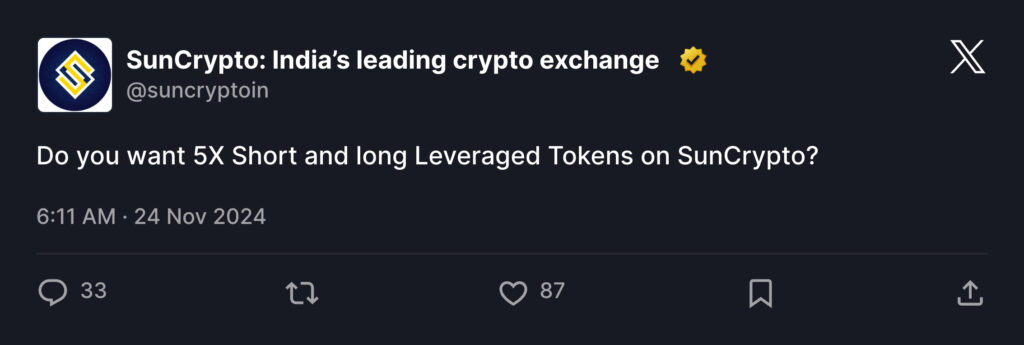
This step demonstrates that we understand our users’ demands and are eager to give them options to increase their revenue source. Although Suncrypto has not yet announced a specific date for the introduction of Leveraged Tokens on its platform, we will inform users and individuals through our social media channels when it does.
Risks Associated With Leveraged Tokens
While leveraged tokens provide opportunities for amplified returns, they come with significant risks that traders need to carefully consider. Understanding these risks is essential before diving into leveraged token trading. Here are the key risks to keep in mind:
- Leverage increases both profits and losses. A small market move against your position can result in big losses.
- Crypto markets are volatile, and leveraged tokens are sensitive to sudden price swings, causing unexpected losses.
- Daily rebalancing can reduce your profits over time, especially in choppy or sideways markets.
- Built-in mechanisms may cap gains, limiting your profit potential in large price surges.
- Designed for daily trades, they’re unsuitable for long-term holding due to rebalancing impacts.
- Leveraged tokens are complex and risky, making them unsuitable for inexperienced traders.
Conclusion
Leveraged tokens offer a unique way to amplify your exposure to the crypto market without the complexities of margin trading. While they can deliver significant rewards in short-term trading, they come with equally high risks, such as amplified losses, volatility impacts, and rebalancing erosion.
These tokens are best suited for experienced traders who understand the market’s dynamics and have a clear strategy in place. Before diving into leveraged tokens, ensure you are fully aware of their mechanisms, risks, and suitability for your trading goals. Remember, in the world of crypto, informed decisions are key to minimizing risks and maximizing returns.
To learn more about Leveraged Tokens, check out SunCrypto Academy.
FAQs
Q1. What is a Leveraged Token (LT)?
A Leveraged Token is a derivative product designed to offer leveraged exposure to the underlying cryptocurrency without margin or liquidation risks. It’s ideal for short-term investments in one-sided market trends.
Q2. What is a Leveraged Token on SunCrypto?
On SunCrypto, Leveraged Tokens represent a collection of Perpetual Contract positions. For instance, trading BTC3L means investing in a basket of BTCUSDT Perpetual Contracts with 3x leverage. Similarly, trading BTC5L means investing in a basket of BTCUSDT Perpetual Contracts with 5x leverage.
Q3. What is Net Asset Value (NAV)?
NAV, or net asset value, reflects the value of a Leveraged Token. It fluctuates based on the price changes in the underlying asset’s Perpetual Contract market. For example, if BTCUSDT increases by 1%, the NAV of BTC3L rises by 3%.
Q4. Why is there a difference between the Spot market price and the NAV of a Leveraged Token?
The NAV is determined by price movements in the Perpetual Contracts market, while the Spot market price is influenced by supply and demand. This causes minor differences between NAV and Spot prices.
Q5. What do Leveraged Token symbols indicate?
BTC3L: Represents a Leveraged Token with 3x long positions on BTCUSDT.
BTC3S: Represents a Leveraged Token with 3x short positions on BTCUSDT.
Q6. What’s the difference between Leveraged Token trading and Derivatives trading?
Leveraged Tokens are simpler as they eliminate margin and liquidation risks, unlike Derivatives, which involve complex management of leverage and margin.
Q7. What are the fees for Leveraged Token trading?
SunCrypto charges 0.1% trading fees on all Leveraged Token transactions. This competitive rate ensures cost-effective trading for users.
Q8. Will my Leveraged Token position be liquidated?
No, Leveraged Tokens come without liquidation risks. However, their NAV can drop to zero in extreme cases, making them unrecoverable. A rebalancing mechanism ensures the leverage remains within a target range (e.g., 3x for BTC3L).
Q9. What is the rebalancing mechanism?
Rebalancing dynamically adjusts the Perpetual Contracts positions to maintain the target leverage. This ensures that market volatility doesn’t push leverage beyond predefined limits.
Q10. Can Leveraged Tokens be withdrawn?
Currently, withdrawals of Leveraged Tokens are not supported on SunCrypto.
Q11. Is there a fixed supply of Leveraged Tokens?
No, the supply dynamically adjusts, ensuring sufficient availability based on demand.
Q12. Are there price limits for Leveraged Token trading orders?
Yes, a price limit of ±10% from the Last Traded Price is applied. Orders beyond this limit will not be executed.
Q13. Where can I view my Leveraged Token trading and rebalancing history?
You can look over your trading and rebalancing history on the same suncrypto page where you placed your order for Leveraged Tokens.
Q14. Are there KYC requirements for trading Leveraged Tokens?
Yes, completing your KYC process on SunCrypto is mandatory during onboarding to access all trading services, including Leveraged Tokens. If you have not completed your KYC process, you will not be able to access any services on the SunCrypto platform.
Disclaimer: Crypto products and NFTs are unregulated and can be highly risky. There may be no regulatory recourse for any loss from such transactions. All content provided is for informational purposes only, and shall not be relied upon as financial/investment advice. Opinions shared, if any, are only shared for information and education purposes. Although the best efforts have been made to ensure all information is accurate and up to date, occasionally unintended errors or misprints may occur. We recommend you do your own research or consult an expert before making any investment decision. You may write to us at help@suncrypto.in.
Urgent leverage system start as soon possible
Urgent leverage system start as soon possible